MoodMaster: mood tracking mobile app design
Background
Based on a recently published study, 138 college students out of 195 students indicated increased stress and anxiety due to COVID-19. Multiple stressors were identified that contributed to increased mental health problems. (Son. et al., 2020)
To gain more complementary findings of college students’ current mental states, I conducted 3 interviews with university students and presented my early concepts with another 3 graduate students to gain feedback on my prototypes. During the interview, I asked questions regarding how their mental health has been impacted during the pandemic, strategies of coping with stress and anxiety, and what other resources and support they might need during the pandemic.
Students reported that the lack of interaction with others has been one of the most profound impacts among other added stress. To cope with the negative impact COVID-19 has brought to their lives, students have been using remote communication tools to chat with their friends and families which has been helpful. In terms of additional support, students would have liked more social interactions with others to improve their social wellbeing.
Current Apps Review
I selected six competitor apps to review based on the three theoretical concepts. Please see the competitor analysis chart I did as part of the secondary research.
Among all the apps I reviewed, only two apps implemented the social support feature. Most apps have the emotion tracking feature, but lack connections between emotion check-in and self-care activities. In addition, most of the apps contain goal-setting features encouraging users to set up specific goals but when users complete those goals, there are no specific rewarding systems designed to motivate users to continue those check-ins.
Theoretical concepts in the app
Combining the secondary research and my conversations with college students, I decided to combine self-monitoring with goal setting and social support and encourage users to track their emotions more frequently. In the following section, I will walk through three major theoretical concepts in my app:
1. Self-monitoring and Goal Setting
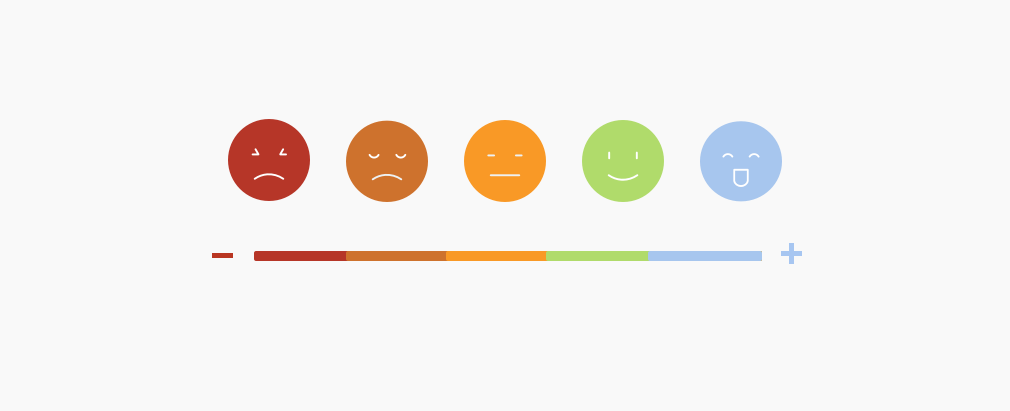
The goal-setting concept is mainly displayed on the profile page. On the profile page, users are able to set their self-care goals for the next day. When they tracked their activities along with the emotions during daily check-in, the self-care dailies section on the profile page will automatically check their goals off so users can see their accomplishments. Moreover, users are able to receive growth stars or emotion scores after each daily check-in. Once users rate their emotions, the happier they rated themselves the more emotion scores they will receive. On the profile page, they are able to see those rewards received. Therefore, if one has higher emotion scores they might be more emotionally stable and happier. If one has more growth stars they are more active self-trackers and track their emotions more frequently.
Peaceful landing page
Rating scale
Track emotions and activities
Profile page
2. Self-monitoring and Social sharing
Self-monitoring could help individuals detect the change of their mood and activities that could be the trigger of those emotions. However, self-monitoring appears to be burdensome for some users since it requires a certain amount of commitment in order to detect those changes. During my conversations with my peers, I realized that social connectedness was highly desired among the group and peer support could have helped shape those virtual connections and reinforce well-being. In my app, I hope to explore how to combine self-monitoring with social sharing to encourage users to use the self-tracking feature more regularly.
Start daily check-in; or navigate to the feeds page
Feedback page when users complete check-in
Share emotion states to gain social support
Share self-care activities
3. Digital therapy
During the interviews, students explicitly mentioned that more resources and help from mental health professionals on how to cope with stress and anxiety is very helpful. I decided to prioritize the asynchronous interaction between college students and mental health professionals because this design allows users to develop their own self-care toolkit or skills when counselors are offline. They are still able to chat with the counselor through the chat feature once they have questions about the materials. The toolkit page allows students to browse self-care resources based on different topics such as Guided Digital CBT, Soundtrack, Breathing, Exercise, and Mindfulness. When users click on join, they are able to start their progress of self-care. When they finish the course, the system will direct them to rate their emotions and follow the same process of self-tracking. This allows the users to see the impact of those self-care toolkits and think about whether they wanted to add those to their self-care dailies.
Accessible mental health toolkit
Complete toolkit created by psychologists
Finish course to gain growth star
Check their emotion after each completion
I did a usability test with one participant before reaching the final design decision. The video walks through three major flows in this app. Please feel feel to interact with my prototype through the InVision app.
Future steps and going forward
If I would like to really develop this app, I would further think about how to design the social aspects of this app better so I could ensure that users could gain feedback from other peers in a positive way. Moreover, if for some reason the students didn’t track their emotions or self care dailies for a while the system should provide some types of push components reminding students to come back to the system. Lastly, I think the rewards mechanism could be more robust if I would like to take the app to the next level. Currently, students gain recognition by gaining growth stars and emotions scores to become more experienced member of the app. In the future, I might consider designing some other rewards that students care about to help them better stick on their self care goals.