
image from center for civic design
MDOS Absentee Ballot Project
Overview
Internship: Citizen Interaction Design Summer Fellow
Client: Michigan Department of State Duration: May 26, 2020 - Aug 14, 2020
Skills used: UX research planning, interviews, participatory design, report generation, accessibility design
Background
Proposal 3 allows no-reason absentee voting and same-day voter registration. Because of COVID-19, the Michigan Secretary of State sent out absentee ballot applications to all registered voters in the state. Our client is especially interested in connecting young voters aged 18-25 with information they need to vote absentee.
Stakeholder interviews
To gain a basic understanding of the problem, we decided to interview a few city and township clerks to learn more about their perceptions on absentee voting and their interactions with young voters. Our research questions for clerks included:
What are clerks’ frustrations around absentee voting during the pandemic?
How did they respond to those frustrations?
How did they interact with voters, including college students?
Do they need any support from the state?
We searched online for clerks’ contact information, and looked for cities and townships where there are universities or colleges. Please see the interview protocol for clerks. Our group interviewed 6 clerks in Michigan. After each interview we transcribed and coded the transcript to reserve anonymity.
Stakeholder interview analysis
Synthesized clerks’ interview data
I worked with another teammate to analyze the interview data and synthesize findings by creating affinity diagrams in Miro. After 10+ hours of debriefing and synthesizing the interview data, we came up with the following high level findings for clerks:
Clerks are optimistic about absentee voting, and believe it can bring benefits to voters.
However, they are concerned about added stress caused by the increased volume of voter turnout.
Clerks used different methods (informational videos, social media platforms, and in-person lecturing) for voter education and indicated that the state should continue informing the public about absentee voting and its process.
They received a high volume of calls and emails from voters about absentee voting
Defining target audience
We realized that clerks are overwhelmed with the process of processing absentee ballots and their applications. Based on findings from clerks’ interviews, they were reaching out to voters including college students for voter education purposes, but there is still further research needed among college students on how they process current education efforts and if they have any questions about this process. Our group decided to conduct more research to learn how students perceive absentee voting, evaluate existing outreach efforts and see how we might be able to help improve students’ absentee voting experience. We started to collect data by conducting secondary interviews and looking for online resources indicating students’ perspectives about absentee voting.
Synthesized data from secondary research
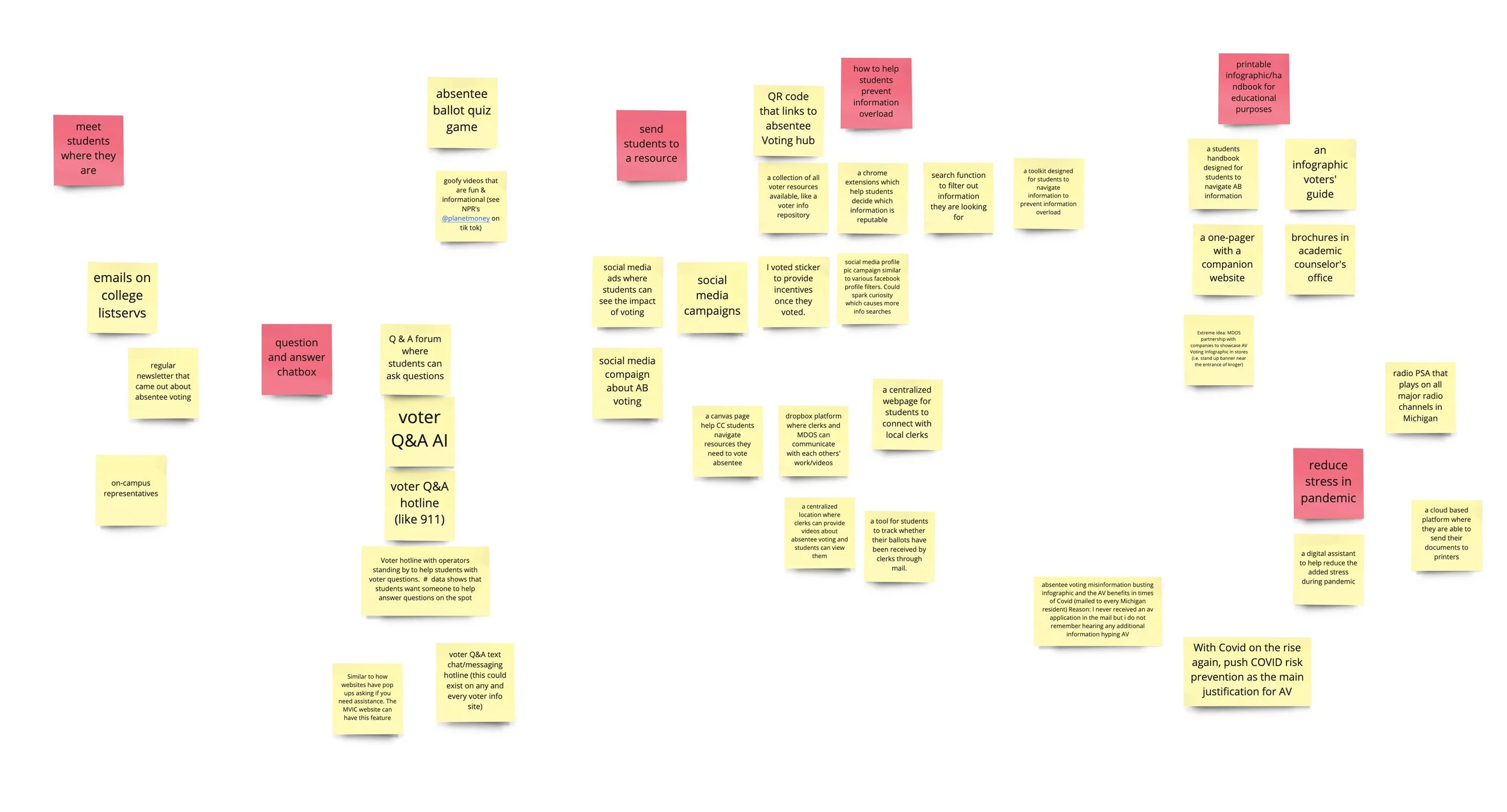
After each team member writing down their insights from secondary research, I grouped similar sticky notes and came up with the high level insights for students:
College students are unaware of a reputable source to receive information related to absentee voting, they often face the problem of information overload. This might result in the outcome that students are not familiar with the voting procedures and process in order to vote or vote absentee.
The majority of students believe that they could make a difference in voting and encourage others to vote. However, students with lower social economic status might lack equivalent education and access to information they need, thus they might be more prone to distrust of the voting system.
When it comes to encouraging the youth to vote, community colleges lack resources and funding to encourage civic engagement compared to 4-year colleges. For example, community colleges often don't have dedicated campus representative or centralized office to increase students turnout .
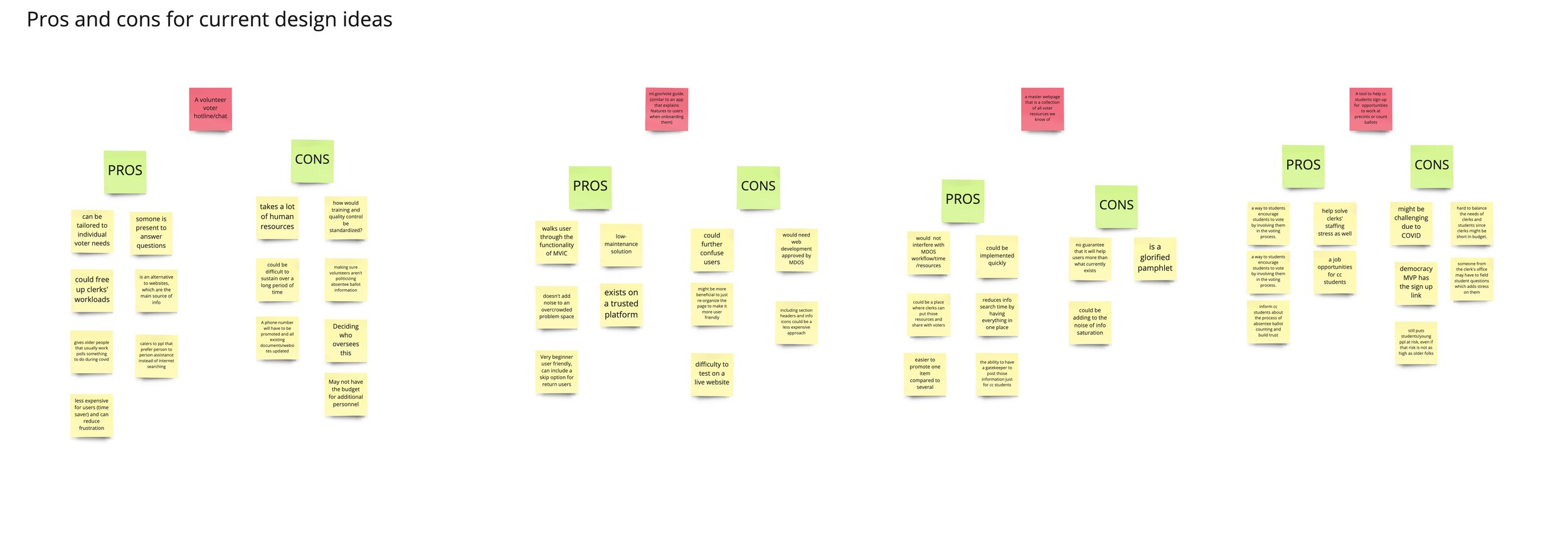
Based on those secondary research, we found that community college students tend to have lower turnout rate and they might be more passive to seek voting information existed on campus. We decided to narrow down our target audience to community college students aged 18-25 to aid existing outreach efforts and align with our client’s goal. We then brainstormed different ideas and compared pros and cons of those design concepts.
Redefine problem statement and plan research with constraints
To gain richer and direct insights from community college students, we reached out to various community partners who previously involved in community college students recruitment and came up with a survey to reach out to community college students. Unfortunately, we had a hard time receiving responses from community college students and community college administrators we reached out to replied that an IRB was required to send out the survey.
Due to the difficulty of accessing cc students and the limited duration of our project, we decided to adjust our target audience to university students ages 18 to 25 who are eligible to vote. We believe the primary findings gained from those interviews will help complement the findings we received from secondary research. After another round of ideation, we have agreed to a concrete problem statement below:
“How might we leverage information from existing trustworthy platforms to help college students answer questions around absentee voting and help them successfully submit the ballot?”
With this redefined problem statement, I led the planning for the online participatory design session and came up with a set of research questions below:
What are college students’ perceptions about voting absentee?
What is their main confusion about the process?
Where do they go when they have questions about absentee voting?
What do they think about our design concepts?
Please see the detailed research plan.
I recruited participants using a screener survey that was sent out to the UMSI listserv. I coordinated those interviews and conducted six interviews and PD sessions with students. Another teammate was present to take notes.
Participatory design in Mural
Analyzing the data
After the session, I worked with another teammate to discuss the insights from those interviews and developed a shared understanding before generating the report. Due to the time constraints, we hope to use a method that could generate design insights quickly. Therefore, I chose the Elito Method (detailed below) to analyze the data and generate design recommendations based on each observation while considering our own judgements as a researcher.
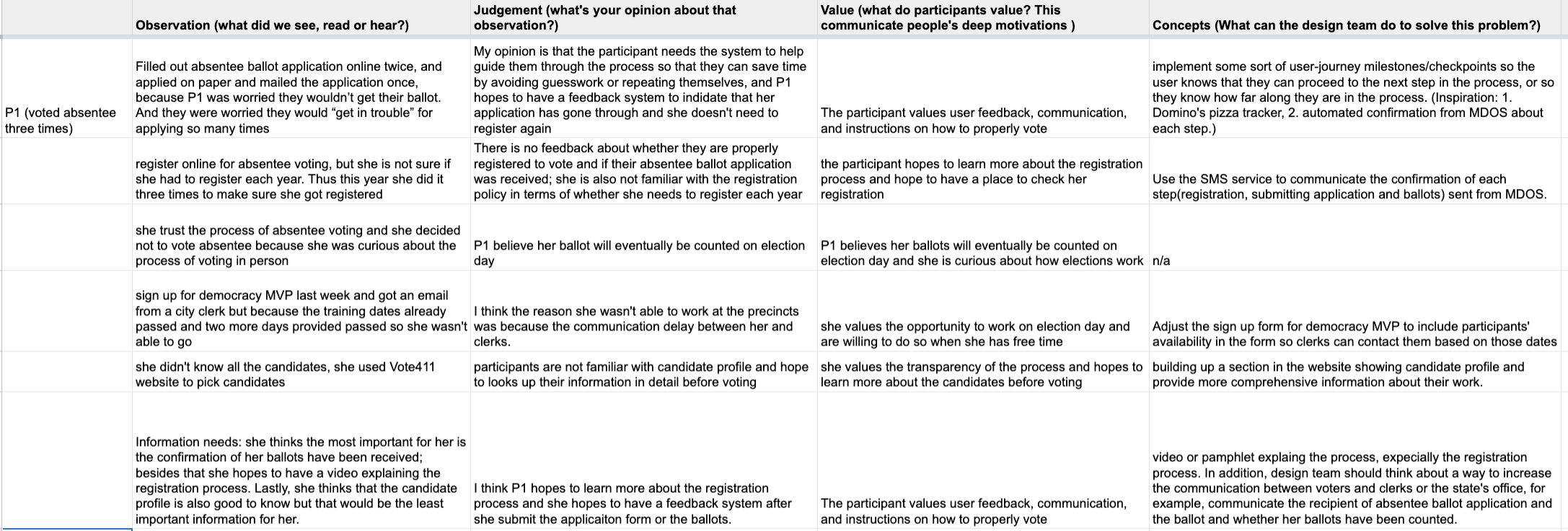
A glance of the analysis from those PD sessions
Findings and Recommendations
Finding 1: Among the six students we interviewed, two expressed some concerns regarding whether the ballots would arrive on time. There was an unclarity around how their ballots will be counted on the election day. Participants indicated that they would have liked a notification once the ballots had been received and counted. All students we interviewed expressed the desire to receive confirmation messages from the state about almost every step of the absentee voting process. For example, they hoped to receive a confirmation of whether their application and ballots were received and what the expected next steps were. P4 mentioned in the interview that he would like to receive a confirmation showing he completed each step correctly and there was enough time left.
Recommendation 1: we recommend providing confirmation texts from MDOS to indicate voters (including university students) have successfully registered, submitted their application and ballots. The confirmation would also include that their ballots had been counted for this election. Based on our previous interactions with clerks, the process of clerks having to manually input thousands of the handwritten forms from voters might slow down their speed to get back to voters. We recommend using SMS service to send confirmation texts to voters once they have successfully registered, submitted applications, and submitted ballots. In addition, the text should also inform them once their ballots have been counted for this election.
We also think SMS could be expanded to other types of voter-to-government communication to maximize the effort of voter engagement. For example, reminding voters of the deadline to register to vote, or to submit applications and ballots on time. It could also be used during election day to prompt users where they should go to find their local polling places.
Finding 2: Students are not familiar with the absentee voting process, especially how long they should spend completing each step, and what to expect after they finish each step. During our interviews, we had each participant go through each step of the process and write down sticky notes of tasks taken for each step of absentee voting, what are some common questions they have and what information they might need in order to answer those questions. After the interviews, I recorded the data and created a journey map containing tasks students took, pain points and questions they encountered and design opportunities for 7 phrases in the absentee voting process.
One pager voter guide
Recommendation 2: based on the paint points discovered throughout the process, we think a video or one-pager student voter guide listing each step of absentee voting with short explanations (timeline, where, how) for those steps would be helpful for students. They can be displayed through the state’s website but also through other channels such as social media and clerks’ websites.
My colleague also created a video version of the voter guide based on this finding, the video explains the five steps students need to take to complete the process, and addresses common questions students have about the timeline, and whether their ballot will be counted on Election Day. We hope this video will also serve as an outreach resource to direct students to michigan.gov/vote website to look for information they might need along the journey. Please watch the video here.
Finding 3: Students prefer text-based communication and most students stated that they will only call the clerks if the questions are complex. A Chatbot aligns more with their expectations for asking questions as they don’t need to go back and forth between phone and a computer. Students also indicated that they were not confident of knowing where to look for help when they had questions regarding absentee voting.
Recommendation 3: Implementing a chatbot along with the hotline option to call the state officials for help. Listing some scenarios to clarify when students could call the number. We suggest that in the long term, adding a chat window in michigan.gov/vote that might help solve some “phone anxiety” among students and provide students a centralized and reliable place to seek the answers they need. In addition, if a hotline is feasible to implement, consider listing some example questions and letting users know that they can call a number for more specific questions. Either way, MDOS should consider both the chat function and the hotline working in tandem, through the state’s website, for students to receive quick answers to simple questions, and more personalized answers for more specific questions, to embrace this diversity of needs.
Mockup 5: chat window embedded in MDOS website to provide some automated answers and direct voters to the correct place of the website to find answers
Mockup 6: chat window confirms with users whether their questions got answered.
Discussion & Future directions
Among our interviews, we found that the information challenge students were experiencing is the lack of a centralized and reliable place for them to find information when they have questions related to absentee voting. We also found that the current Michigan.gov/vote website could add additional information related to the candidates to help students make voting decisions. Besides our three main recommendations, we also recommended MDOS continue building the website and improve the connectivity between pages. In the future, we hope we can recruit some community college students to test our design concepts with them and iterate our solutions if possible.
After this project we delivered our report of findings and recommendations to our client, our client think the information provided is very helpful and they are continuing building the website more tailored to students’ needs.